
Celva / Treatments / IV longevity & performance

Medically reviewed by the Celva medical team · June 2026

§ 002 / Treatment · Systemic & preventive

Maintain the body,
before it asks for repair.

Systemic MSC infusion is the quieter side of regenerative medicine. Delivered intravenously, it works everywhere at once. For patients moving from reactive care to proactive maintenance: energy, recovery, inflammation, mental clarity, performance, resilience.

Session
45min
In-chair infusion time
Dose
Setper case
Weight-adjusted allogeneic MSCs, never off the shelf
Cadence
1–2/yr
Typical maintenance schedule
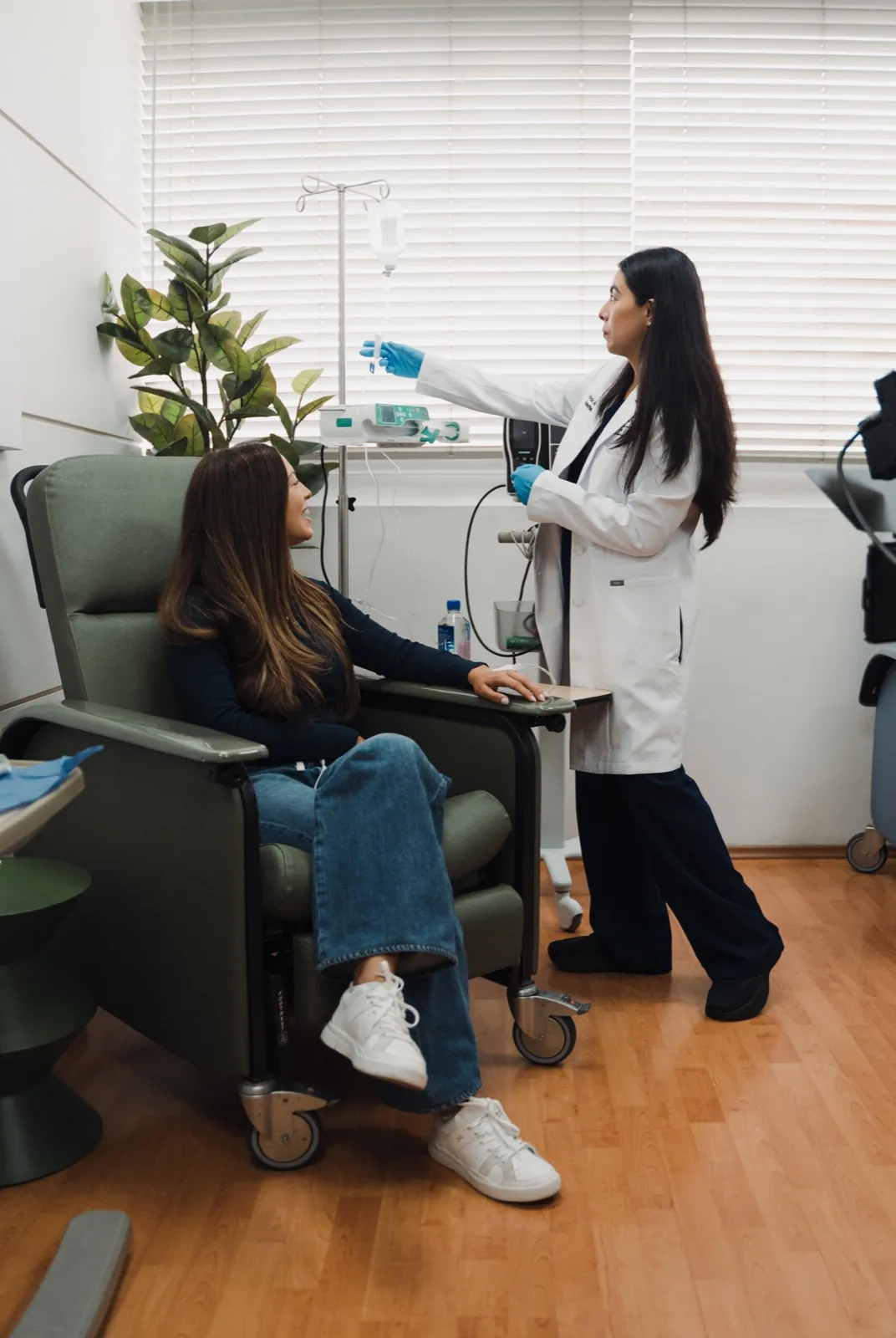
A patient seated in an infusion chair while a Celva clinician adjusts the IV line
FIG. 02 · Systemic Delivery Whole-body distribution
§ 002.1 / Audience

Three patients.
Same therapy, different goals.

This isn't one-size-fits-all. The same therapy can serve very different goals, so we shape each plan around the reason you came to us.

I.
Track · Rejuvenation

Feeling youthful again

  • Your energy runs low, and rest doesn't recharge you the way it once did.
  • Your skin has lost a little of its glow, and you look more tired than you feel.
  • You miss feeling youthful: bright, vibrant, and fully yourself.
  • You want to rejuvenate from the inside out and carry that glow into the years ahead.
  • A relaxed first call to see where you stand
  • A visit or two a year, planned around your life
  • Works best alongside good sleep and movement
II.
Track · Recovery

Asking a lot of your body

  • You ask a lot of your body, and lately it has been asking for something back.
  • The aches hang around longer, and the bounce-back between hard efforts takes more out of you.
  • Nothing is wrong, exactly, but you can feel the miles adding up.
  • You want to keep training at full strength, with your body supported to keep pace.
  • Planned around your training, not against it
  • Usually a visit or two across the year
  • We follow how you feel and how you perform
III.
Track · Renewal

Finding your way back

  • You have been through something hard: a surgery, a serious illness, or a long stretch that knocked you flat.
  • Now you want to feel like yourself again, on an honest path back.
  • Our medical team begins by reading your history closely, so the plan meets you where you actually are.
  • The climb back, taken one steady step at a time, with people firmly in your corner.
  • Begins with a careful medical review
  • A short series of visits, close together
  • We stay in step with your own care team
§ 002.2 / Mechanism

Where the cells
actually go.

IV-delivered MSCs are not "pumped into a joint." They circulate. Most transit the lungs first (which is where they do some of their most interesting work) and from there signal throughout the body.

01

Infusion

Screened allogeneic MSCs, washed and counted before release, delivered through a peripheral IV over ~45 minutes.

02

First-pass lungs

Most cells transit the pulmonary capillary bed first. Residence time here is hours, and where a large share of immunomodulatory signaling occurs.

03

Systemic distribution

Cells traffic to sites of inflammation, ischemia, and tissue stress, attracted by cytokine gradients released by damaged tissue.

04

Paracrine signaling

Cells release extracellular vesicles and growth factors that modulate local immune response, reduce inflammation, and support resident repair cells.

05

Signaling persists

The cells are the trigger. The signaling cascade they initiate (reduced inflammation, modulated immune activity, activated repair processes) continues well beyond the cells themselves.

How the cells work: four simultaneous mechanisms

Anti-inflammatory

Reduces the chronic inflammatory signaling that contributes to pain, dysfunction, and progressive tissue damage, systemically.

Anti-fibrotic

Attenuates the fibrotic cascade that replaces functional tissue with scar tissue, a downstream consequence of chronic inflammation.

Immunomodulatory

Recalibrates dysregulated immune activity across the body without systemic immune suppression.

Pro-angiogenic

Supports formation of new vascular networks, contributing to tissue perfusion and a more favorable systemic repair environment.

Why immunomodulation matters for longevity

A meaningful share of age-related decline is immune dysregulation, the chronic low-grade inflammation researchers call "inflammaging," which progresses with age and contributes to most age-related conditions. MSC immunomodulation is the part of the mechanism set most directly relevant to preventive use: recalibrate the immune environment without suppressing it.

NOTE This is a simplified model. MSC behavior in vivo remains an active research area, and clinical benefit is not fully explained by any single mechanism. We describe what we observe and what the literature supports.

Your protocol

The protocol, in cells.

IV longevity protocols typically use umbilical-cord MSCs, occasionally blended with bone-marrow MSCs depending on your goals and clinical history. Dose is weight-adjusted (cells per kilogram), tuned to your case. Not a fixed package. Why we use multiple cell types →

§ 002.3 / Protocol

The IV protocol,
in specifics.

Same methodology as our joint program, different numbers. No anesthesia, no procedure room, no recovery time. You arrive, infuse, leave.

Source
Allogeneic UC-MSCs, BM-MSC blend in select cases
Dose
Weight-adjusted, set per case
Delivery
Peripheral IV, saline carrier
Sessions
1–2 per year depending on goal
Anesthesia
None
Duration on site
~2 hours total
Return to activity
Same day, full normal activity
01 / Pre

Baseline panel

Comprehensive blood work: CBC, CMP, inflammatory markers (CRP, IL-6), ApoB, HOMA-IR, HbA1c. Sleep, HRV, and symptom questionnaire. Baseline we can measure against.

~2 wks pre-visit · virtual
02 / Day-of

Intake & vitals

Arrival, updated vitals, IV placement by our infusion RN. Private infusion suite. You'll be awake, comfortable, and can work or read.

~20 min intake
03 / Infusion

MSC delivery

Before your dose is infused, the cells are carefully washed, counted, and checked for viability, so you receive the strongest cells from the batch, not whatever was in the vial. The infusion then runs at a controlled rate over ~45 minutes, with vitals monitored throughout. Sensations are typically nothing beyond mild warmth.

~45 min · infusion suite
04 / Observation

Post-infusion hold

Monitored rest, hydration, discharge instructions. Discharge is authorized by the attending physician once observation is complete.

Physician-set · hospital suite
05 / Follow-up

Re-measure, re-plan

We repeat your baseline panel and review how you are doing overall. Biomarkers do not always capture the benefit, so we weigh the labs alongside how you feel and function, then co-author the next-cycle plan. We continue when there is a real reason to, and hold when there is not.

60 / 90 days · virtual
§ 002.4 / Floor

What we
don't claim.

Systemic MSC therapy is a careful tool, not a cure-all. The honest ceilings, before you ask.

Limit 01

Not anti-aging.

No therapy reverses biological aging. We frame IV MSCs as systemic support for inflammation, recovery, and resilience, not as a clock-rewinder.

Limit 02

Not a cure.

Cell therapy does not cure disease. Where it helps, it modulates the underlying environment. That is meaningful, and it is not the same as cure.

Limit 03

Not permanent.

Duration varies by indication and individual response, and the physician team discusses what's realistic for your case. Anyone calling regenerative results "permanent" is selling, not informing.

Limit 04

Not a substitute.

If you have an underlying disease being managed by another physician, IV MSC therapy is not a replacement for that care. It works alongside it, and we share records with your existing care team.

§ 002.5 / Experience

What patients
actually feel.

A realistic timeline, infusion day through 6 months, of what IV recipients typically report. Not everyone follows this curve, and we tell you when yours is outside it.

Day 0
In-chair

Mild warmth as the infusion runs. Occasional brief flush. Nothing dramatic. This is a quiet procedure by design.

Day 1–3
Immune echo

Some patients describe a brief "activation": mild fatigue, slightly elevated temperature, vivid sleep. Typically subsides by day 3.

Week 2–4
Early signal

Sleep quality and recovery first. Small things: legs heavier for less time after training, calmer inflammation, fewer minor aches.

Month 2–3
Measurable shift

Inflammatory markers trend down on re-draw. HRV often up. Subjective energy and cognitive clarity reports peak here for most patients.

Month 6
Decision point

Re-measurement panel. We decide together: maintain, extend cadence, or conclude this cycle. No automatic re-bookings.

§ 002.6 / Next step

Every protocol is
built per patient.

An IV longevity protocol is designed around your biomarkers and goals, not a fixed package. Celva's physician team at Hospital Angeles, Tijuana reviews your panels and history, then sets the infusion plan and cadence for your situation. Most patients return one to two times per year. The benefit compounds: each infusion builds on the last, so a maintained cadence does more than scattered one-offs. We re-measure first, and continue only when it earns it.

Start an intake and a Celva patient coordinator gathers your case for that review. Nothing is scheduled until the team has weighed in and you have decided to move forward.

Find out if you're a candidate →
§ 002.8 / Questions

IV-specific
questions.

Q.01 Isn't this just an expensive IV vitamin drip?
No. IV vitamin drips deliver water-soluble nutrients (electrolytes, B vitamins, and similar). They have a place, but they're not cell therapy. A Celva IV is an infusion of living, screened, culture-expanded allogeneic mesenchymal stem cells. The biological mechanism is in a different category entirely.
Q.02 How long does the effect last?
The cells are the trigger. The signaling cascade they initiate (immune balance, local repair, biomarker trajectory) persists long after the cells have done their work. Maintenance cadence is typically 1–2 per year. Some patients feel shifts longer, some need tighter cadence. The physician team discusses what's realistic for your case; we re-measure before any re-booking.
Q.03 Do I need imaging or specific diagnoses to qualify?
No. IV tracks are open to generally-healthy adults who complete our medical intake and baseline bloodwork. If you have a specific diagnosis (autoimmune, cardiac, post-surgical), our medical team reviews your records and we'll often want additional testing before dosing.
Q.04 What's the downside I should know about?
Three honest ones. First: effects are systemic and quiet. Some patients don't feel much subjectively even when biomarkers shift, which can feel underwhelming if you were expecting a peak. Second: this is not FDA-approved in the US. We operate under COFEPRIS regulation in Mexico, and that's a decision you should make eyes-open. Third: the long-term data is still unsettled. You'd be acting on strong early evidence, not decades of it. We tell you this plainly before we book you.
§ 002.9 · Start here

Start with one
honest infusion.

Begin with a single discovery visit. Full baseline panel, one infusion, a protocol Celva's medical team designs for your case. If it's not delivering measurable signal at 90 days, we say so. And no next infusion is booked.

See if you're a candidate →
Not medical advice. Individual results vary. All patients undergo screening before treatment is recommended. Allogeneic cell therapies are performed by the physician team at Hospital Angeles, Tijuana, regulated by COFEPRIS in Mexico.