Hospital Angeles Tijuana: a hospital, not a freestanding clinic
Celva operates inside Hospital Angeles Tijuana, a 116-bed acute-care hospital in the Angeles Health network. Our regenerative-medicine suite is a wing of the hospital, sharing its ICU, operating rooms, ER, imaging, blood bank, and on-call staff.
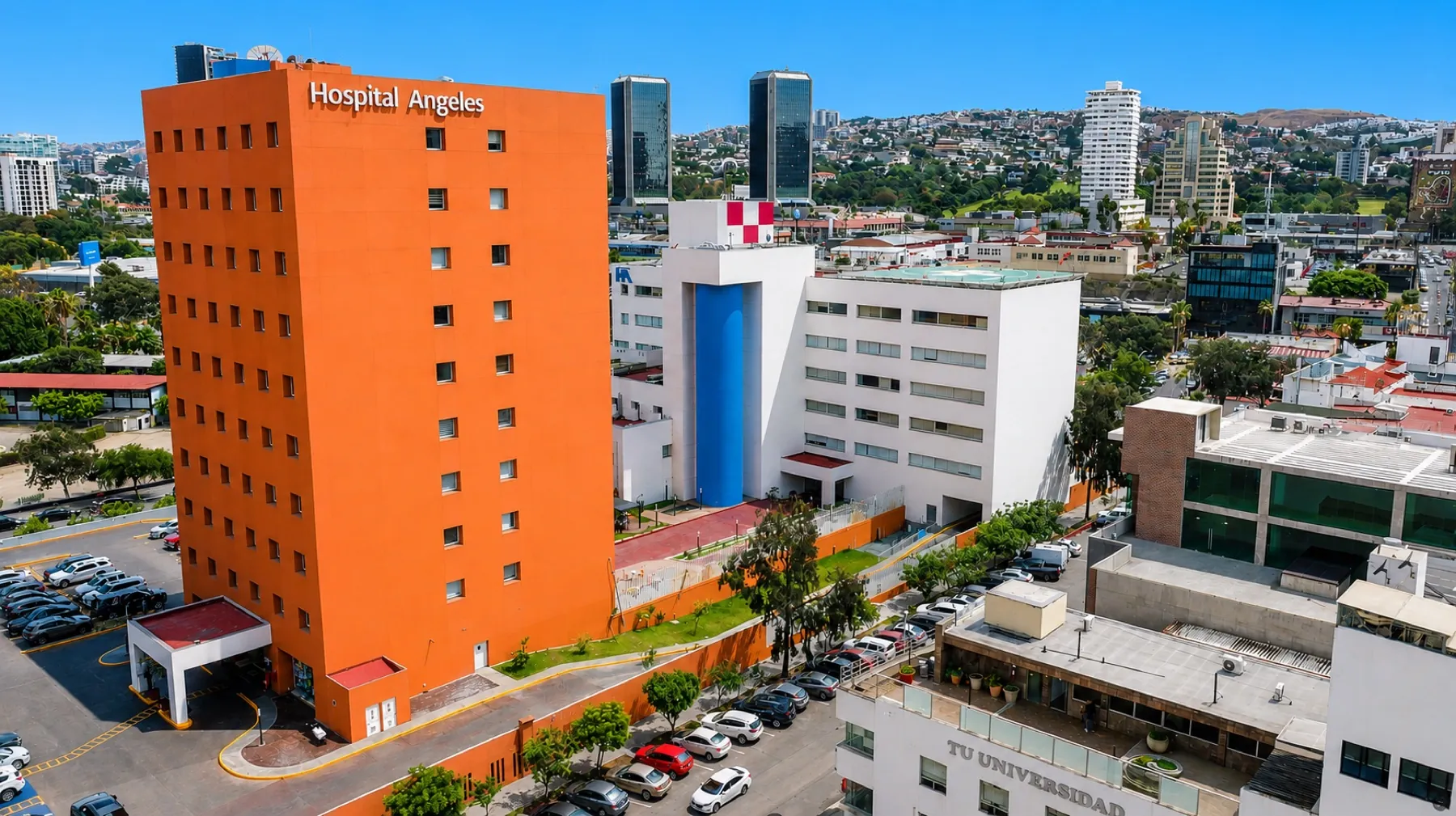
Why does it matter where stem cell therapy happens?
The medical-tourism listings call all of them clinics. A converted office suite above a strip mall is a clinic. A standalone IV-bar in a low-rise building is a clinic. A fully-credentialed hospital wing with its own ICU in the same building is, technically, also a clinic.
Most regenerative procedures go uneventfully. The reason to ask about the setting is for the small fraction that don't. A hospital-based program puts an ICU, an OR, an ER, and a credentialed on-call team in the same building as your suite. A freestanding clinic puts them in someone else's building.
Inside Hospital Angeles Tijuana: the departments down the hall
Hospital Angeles Tijuana belongs to the same Angeles Health chain that runs flagship facilities in Mexico City, Guadalajara, and Monterrey. When you walk into a hospital-based program, your treatment suite is one room in a building containing dozens of medical departments. If anything goes sideways, those departments aren't down the street. They're down the hall.
The departments within walking distance of our suite. Each is staffed, credentialed, and accessible to your case under the same chart number: no transfer, no re-intake, no ambulance call. The ICU is in the same building. Not a 911 call.
Read moreShow less
A freestanding clinic, by contrast, occupies a single floor (often a single suite) in a non-medical building. The nearest emergency department is somewhere else, sometimes across the city, sometimes across a border crossing. Every box above becomes a separate phone call to a separate facility that has no record of you.
If you need a specialist consult, an imaging study, or an ICU bed, your record moves with you. One institution, one chart number.
- Regenerative medicine suite Celva
- Emergency department Open 24/7
- ICU Intensive care In the same building
- Operating rooms Surgical area In the same building
- Cardiology Cath lab on-site
- Imaging MRI, ultrasound, X-ray
- Blood bank On-site
- Pharmacy On-site
- Pathology and lab In-house
Your suite Critical-response, same building Supporting services, same building
Who licenses and inspects Hospital Angeles Tijuana?
A free-standing clinic in Mexico operates under a single license, a regional health-services permit, the equivalent of a medical office permit in the US. A hospital operates under additional federal and national layers. Hospital Angeles Tijuana holds both.
COFEPRIS hospital license
Mexico's federal health regulator. A hospital category license requires inspection, ICU and surgical capacity, defined emergency protocols, and ongoing reporting. Most freestanding clinics hold a lower-tier "consultorio" or "ambulatory" permit instead.
Consejo de Salubridad General (CSG)
Mexico's national hospital accreditation body, peer review modeled on US hospital accreditation. Inspects governance, safety culture, infection control, and patient-rights frameworks. Renewed on a defined cycle, not a one-time pass.
None of this is a magic shield against bad outcomes.
It's the difference between operating under two concentric layers of inspection and operating under one regional permit. The reporting requirements alone (every serious adverse event documented, reviewed, and reported up the chain) change the operating posture of the institution.
Who else is in the building on treatment day?
The Celva team is small by design. Our physicians, named on every chart. The hospital around us is not small, and that's the point. The specialists, the on-call staff, the technicians, the imaging, the lab: all of them work for Hospital Angeles, all of them are credentialed under the same hospital-wide governance program, and all of them are accessible to your case if a consult is needed.
Freestanding clinic
What's in the building
- The treating physician (sometimes part-time)
- One or two nurses or medical assistants
- A front-desk coordinator
- An emergency cart with epinephrine
- No on-call anesthesiologist, ICU, OR, or imaging
- No blood bank, no cath lab, no after-hours pharmacy
Hospital Angeles Tijuana
What's in the building
- An emergency department open 24/7
- Anesthesiology on call
- ICU staffed continuously
- Operating rooms, surgical teams on rotation
- Imaging (MRI, ultrasound, X-ray) in the same building
- Blood bank, pharmacy, in-house lab
This isn't about needing all of it. It's about the difference between being one of many patients in a working acute-care hospital and being the only patient in a converted office suite.
Read what the phrase "hospital setting" has to meanFive questions that show any clinic's real setting
Marketing language about "hospital-grade" or "medical-center" is unregulated. The actual answers are public record. Five questions that produce verifiable answers:
-
Plug it into Google Maps and street view. A hospital looks like a hospital; a clinic above a dental office looks like exactly that. Street view doesn't read the brochure.
Verify: Google Maps (opens in a new tab)
-
Hospital, consultorio, or ambulatory: different categories with different inspection requirements.
-
The Consejo (CSG) maintains a public directory of nationally certified hospitals in Mexico. The facility's name will or will not be on it.
Verify: gob.mx/csg (opens in a new tab)
-
The acceptable answer names a unit and says where it is. "We'll arrange transport" is a 911 call in different words.
Verify: ask the clinic
-
A clinic answer is "we're closed and you have the doctor's cell." A hospital answer names the on-call team in the building.
Verify: ask the clinic
All five from one clinic? If the answers come back in plain language with named units, locations, and license numbers, that's the operation. If they come back evasive or marketing-toned, you have your answer.