Why have stem cell therapy inside Hospital Angeles Tijuana?
We treat inside a hospital, not a clinic: Hospital Angeles, Tijuana, with on-site emergency, intensive care, imaging, and anesthesiology. The infusion happens in the same building as the ER and the ICU, and the physicians on every chart carry hospital privileges there.
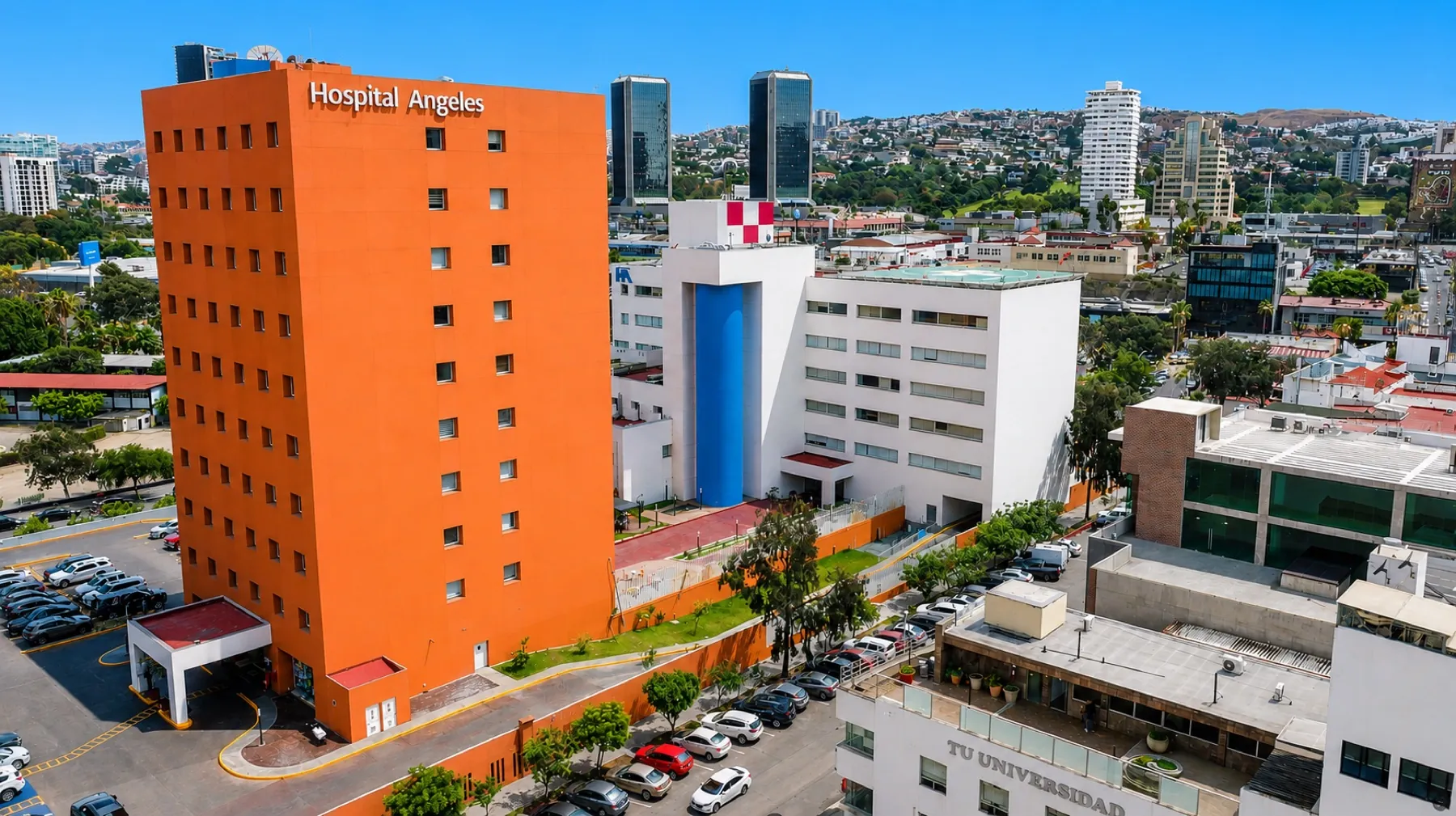
Why does the building matter for a cell therapy?
There are several dozen clinics in Tijuana that will sell a person an MSC infusion. Why ours, and not one of the others?
Because every other dimension that matters is downstream of one fact: the building is a hospital.
A clinical-grade vial, a cGMP lot, an ISCT-characterized population of MSCs: necessary, not sufficient. The other half of a cell therapy is the building it is delivered in. Who is in the room. What is in the building with you. What the building is equipped to do at minute thirty.
That building, for our patients, is Hospital Angeles, Tijuana. Multi-specialty, with on-site emergency, intensive care, imaging, and anesthesiology. The infusion happens inside it, in the same building as the ER and the ICU.
Read moreShow less
The same standard the hospital meets for surgery and ICU care extends to how the cells are received, stored, prepared under tightly controlled conditions, carried by hand to your suite, and, for a targeted case, placed under imaging rather than by feel. The cells are manufactured in the cGMP lab at Hospital Angeles rather than bought from an outside supplier.
“Hospital setting” on a competitor's website usually means none of that. Everything that follows is downstream of that one structural fact: the physicians the hospital credentials, the cell-handling standard the building enforces, the SAE pathway the on-site ER and ICU make real, the vetting that turns away inquiries the indication doesn't support, and the follow-up calls that start at 1 week and settle to once a year.
A free-standing clinic's safety plan is a phone number. In a hospital, the ER is in the building with you.
Who are the physicians at Celva?
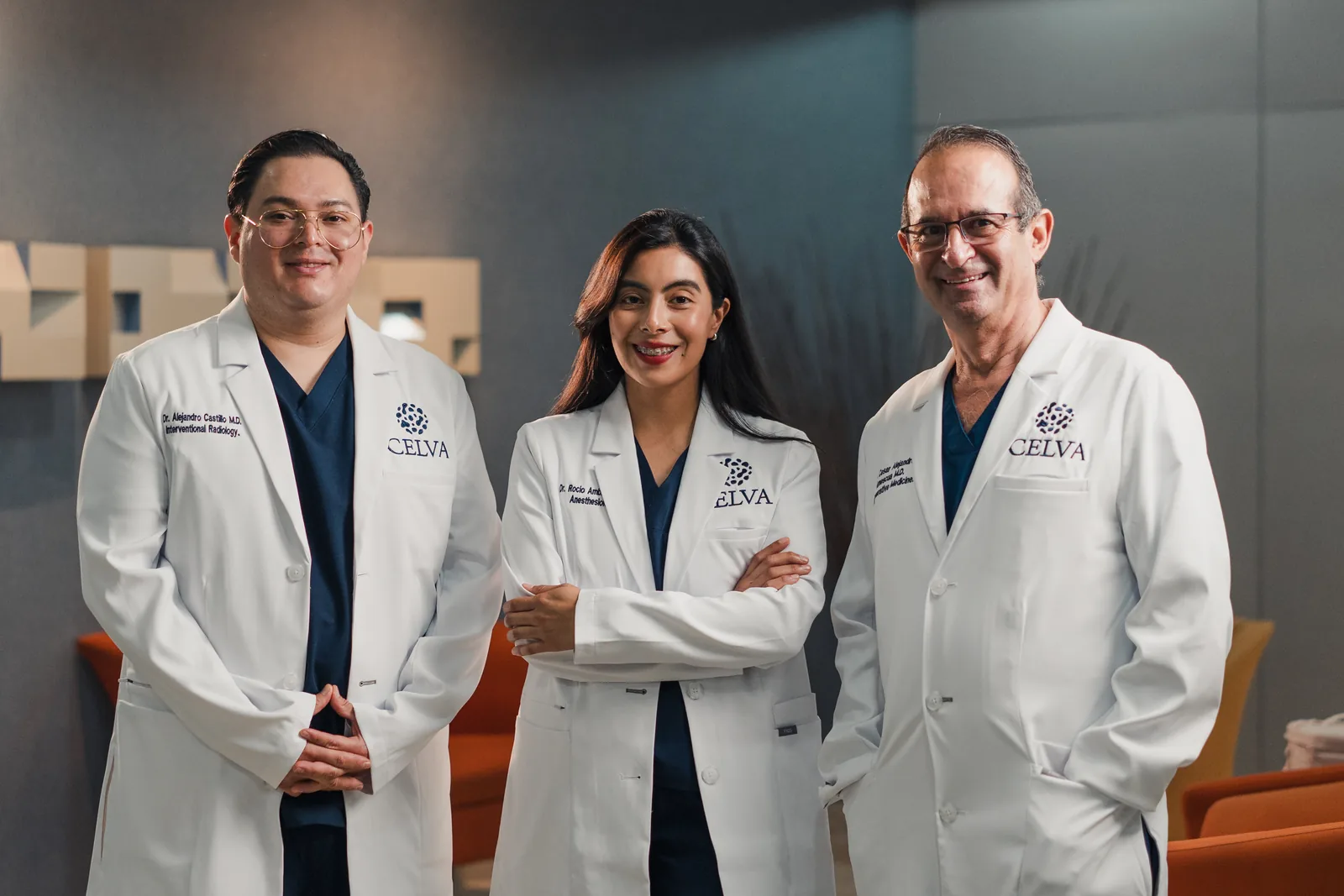
- Dr. Alejandro Castillo Interventional radiology
- Dr. Rocio Ambrosio Nuño Anesthesiology
- Dr. Cesar Amescua Medical director
Dr. Cesar Amescua, Dr. Rocio Ambrosio Nuño, and Dr. Alejandro Castillo are the physicians on every chart, and the physician team that reviews every candidate before treatment.
Our physicians share one chart. They all carry hospital privileges at Hospital Angeles, which means the building is institutionally answerable for the work they do inside it. Every candidate is reviewed by the physician team before treatment is approved. A nurse runs every infusion and the attending physician supervises, and a targeted dose is placed by hand, under ultrasound or fluoroscopic guidance, into the joint or the tissue rather than pushed down a line and left to find its own way.
Read moreShow less
Where the cells land, and how they are handled on the way there, is part of the treatment, not an afterthought to it. Every follow-up cycle is logged against the same record. The names on the door are the names on the consent form are the names on the discharge summary. A clinic that will not put a physician's signature on your treatment plan does not have a physician on your treatment plan.
What happens if something goes wrong?
Most patients never need any of this, which is exactly why it's worth stating plainly. A hospital setting means the safeguards are already in place rather than assembled in a hurry: on-site emergency, intensive care, and anesthesia in the same building, not a phone call away.
- Detect monitoring
- Escalate page MD
- Admit ER / ICU
- Disclose family, log, review
The four-step response, detect, escalate, admit, disclose, is written down, posted in the suite, and rehearsed twice a year, so a rare event meets a prepared team instead of an improvised one. None of it exists without the hospital. The safeguards come with the building.
What happens before and after the treatment day?
1 call. A 15-minute call with a patient coordinator, then your records, the physician team's review and a written answer.
4 calls. Follow-up calls at 1 week and at 1, 3 and 6 months, then once a year.
- First call
- Your records
- Review and written answer
- Treatment day
- Week 1
- Month 1
- Month 3
- Month 6
- Once a year
The hospital framing also shapes what we will not do. We turn people away. A significant share of inquiries are declined. Sometimes the indication is wrong for MSCs. Sometimes the patient is, right now, too unstable to travel. Sometimes the honest answer is we cannot help. A clinic that never says that is selling something other than medicine.
Six articles, in order.
Each article stands alone. Read in order, they answer the question in the title and, more usefully, give you the words to ask it of any other clinic. (Not every clinic will enjoy the questions.)
- The physicians Dr. Cesar Amescua, Dr. Rocio Ambrosio Nuño, Dr. Alejandro Castillo. The physician team that reviews every candidate and supervises every treatment.
- Hospital, not clinic The structural difference between a free-standing clinic and a hospital-based program. Why we operate inside Hospital Angeles Tijuana, and what that buys you when something goes wrong.
- “Hospital setting”: what that means The phrase shows up on many clinic websites. Here is what it has to mean: a hospital license, emergency care in the building, audits against a hospital standard, and one chart held by one institution.
- What happens if something goes wrong Occasional mild flu-like symptoms in IV patients, expected post-injection soreness, the rare events that can occur, and the SAE protocol that manages them.
- How we vet candidates The first call and the physician team review that decide who is treated and who is declined or deferred. A significant share of inquiries are declined.
- What follow-up actually looks like Follow-up calls at 1 week, then at 1, 3 and 6 months, then once a year. What we ask, what to watch for, and how each call feeds the next.
What this clinic is not.
An operation can be described by what it does. It can also be described, more precisely, by what it will not do. Five claims we don't make, and wouldn't let our marketing make either.
-
Not a high-volume program.
We treat a small number of patients each week so that every candidate gets a real medical review and every infusion is run by a nurse with the attending physician supervising. A clinic that runs forty infusions a day is selling throughput. If that's what you want, we're not the right clinic for you, and we'll say so on the call.
-
Not “we treat everything.”
The list of indications MSCs are reasonable for is short, and we publish it. For indications outside it, we decline. The honest sentence “this is not what we do” is almost never spoken in cross-border medicine. We say it to a significant share of callers.
Read moreShow less
-
Not a free-standing clinic in a strip mall.
Many MSC programs in Tijuana operate from converted office space, with the word “hospital” attached by adjacency rather than by license. We operate inside Hospital Angeles, a multi-specialty hospital in the Angeles Health network. If the difference does not matter to you on day one, it will matter on the rare day when something goes wrong.
-
Not silent on bad outcomes.
SAEs are logged. Disclosures are made: to the patient, to the family, to the annual safety review. Every serious event is documented and reviewed. A clinic that has never logged an adverse event has never measured one.
-
Not “it worked” on every chart.
Some patients improve substantially. Some improve modestly. Some do not improve at all. At the 6-month review we give you the honest answer, not the version the marketing department wants. If you want testimonials, every clinic on earth has them. We'd rather tell you the range.