Stem cell doctors in Tijuana: who treats you at Celva
Celva's stem cell doctors at Hospital Angeles, Tijuana are Dr. Cesar Amescua, the medical director and spine specialist who designs every protocol and leads the procedures; Dr. Rocio Ambrosio Nuño, the anesthesiologist who runs your sedation and monitoring; and Dr. Alejandro Castillo, the interventional radiologist who reviews your imaging with you and runs the ultrasound or fluoroscopy that guides each injection in the suite. The same names appear on every protocol, every case review, every difficult judgment about whether to proceed.
This page exists so you know who they are before you talk to them. None of them is a stock photo.
Dr. Cesar Amescua, MD, Medical Director
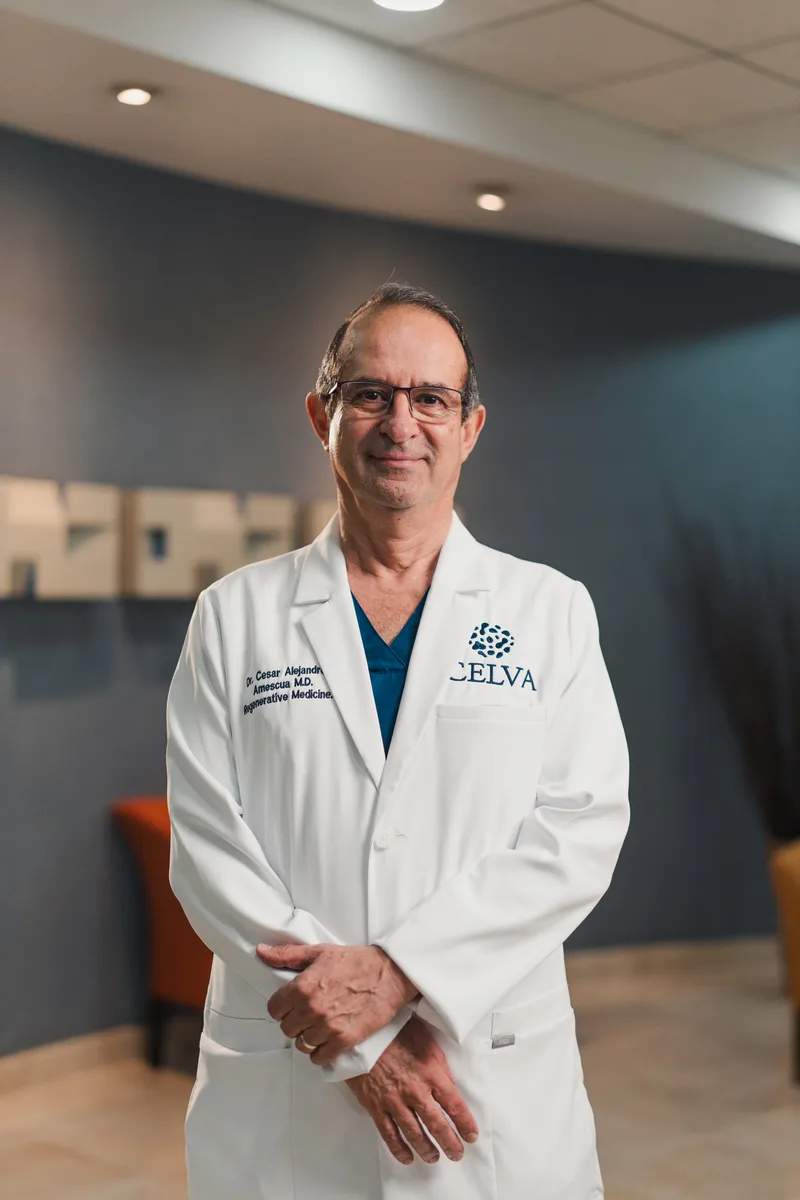
Founding physician, spine & pain medicine, nearly two decades MSC work
Nearly two decades of mesenchymal stem cell work, going back to before "MSC" was a marketing term. UNAM medical degree, a background in pain medicine and anesthesia, and Hospital Angeles affiliation. He is the spine specialist and the main treating physician: he runs the clinical program, decides what protocols we offer, what dose, what cell source, leads the interventional procedures, and, most importantly, which cases we don't take.
- Education
- UNAM medical degree; pain medicine and anesthesia; tissue engineering & regenerative medicine postgraduate work
- Owns
- Protocol design, candidate selection, case review, and leading the interventional procedures
- You meet
- At the hospital, before your treatment.
Read moreShow less
Your first call is a 15-minute call with a Celva patient coordinator, who gathers your records. The physician team then reviews your case, and you get a written answer.
His position on this field is direct: less marketing, more mechanism. He is skeptical of any clinic that claims to treat everything, and he is willing to tell a paying patient that they are not a good candidate. The vetting process exists because he insists on it.
Dr. Rocio Ambrosio Nuño, MD, Anesthesiology & Sedation
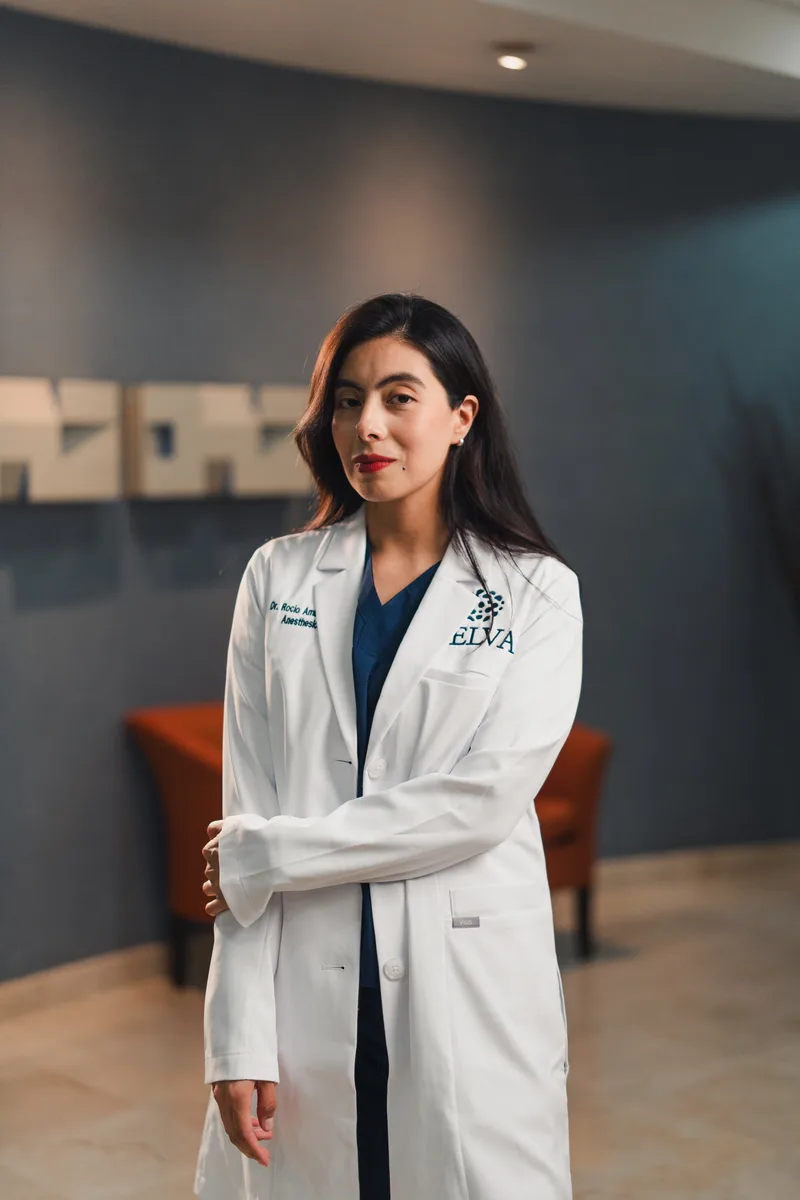
Anesthesiology residency at Universidad Autónoma de Sinaloa, then trained directly under Dr. Amescua in interventional and regenerative procedures. An anesthesiology background means she thinks about monitoring, dosing, and patient safety automatically. It isn't a checklist she runs through; it's how she watches a room.
- Education
- UABC medical degree; anesthesiology residency, UAS; procedural training under Dr. Amescua
- Owns
- Twilight sedation, in-suite monitoring, and the patient-safety protocol
- You meet
- In pre-op, and always at the bedside during the procedure.
Read moreShow less
When you're in the procedure suite at Hospital Angeles for a direct injection into a shoulder, knee, or hip, she runs your twilight sedation, if you choose it, and watches your vitals throughout. You meet her before the procedure, and she walks you through what will happen. Then she keeps you comfortable and safe while it happens.
Patients consistently report that meeting her first changes the experience. We hear this often enough that it is no longer a coincidence.
Dr. Alejandro Castillo, MD, Interventional Radiology
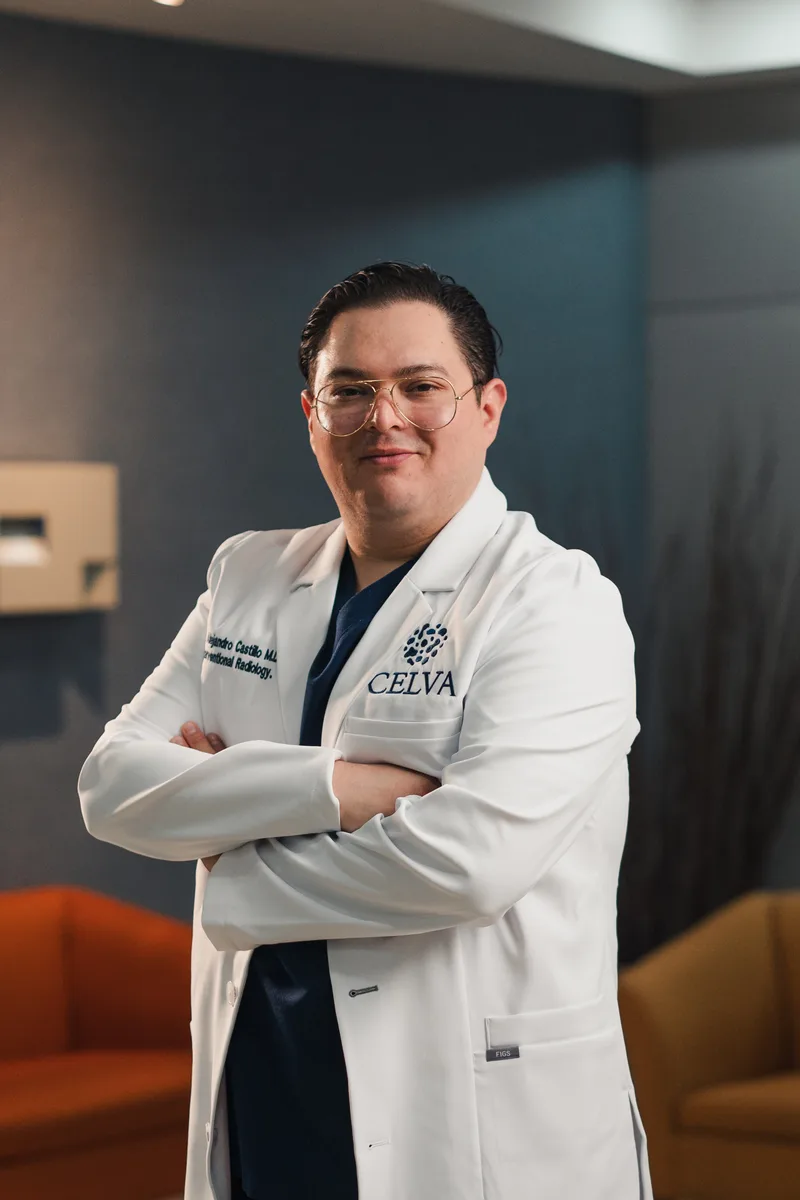
Dr. Castillo is an interventional radiologist. Most patients meet him as part of the protocol: he reviews your MRI and imaging with you before the procedure, walks through the treatment, and then runs the ultrasound or fluoroscopy that guides each targeted injection in the suite. He is also training under Dr. Amescua in interventional spine and direct injection procedures.
- Education
- MD; interventional radiology
- Owns
- Imaging review with patients, in-suite ultrasound and fluoroscopy guidance, and evidence audits
- You meet
- When he reviews your imaging with you, and again in the suite during the procedure.
Read moreShow less
The same eye that reads imaging reads the literature. Cochrane reviews, ClinicalTrials.gov registry scans, monthly reads of Cytotherapy, Stem Cell Reports, and the Journal of Translational Medicine. The job is to tell the clinical team when a case is outrunning the evidence, and his work shows up in the language we use with patients: the ranges instead of promises, the contraindications that exclude certain conditions, the protocol revisions when new trials change the picture.
A clinic without this role tends to recommend treatment for everything. With this role, the answer "this isn't a good fit for what the cells actually do" is on the table from day one.
Will I see the doctor whose name I read on the website?
It's a common question on the first call. Here's the answer: every patient-facing stage of care, who's there, and what they're doing.
-
First call
About 15 min, before travel
A 15-minute call with a patient coordinator: history, imaging, prior treatments, and the records to send. Send whatever records you have, in whatever order they're in. Notes go on the chart immediately.
- Coordinator
-
Case review
Before you travel
The physician team reviews your records and the protocol against current evidence. Castillo flags anything where the literature has shifted. A complex case gets an extended call with the physician team before the decision. Then a written answer: approval or revision; sometimes a "no."
- Amescua
- Ambrosio Nuño
- Castillo
-
Arrival & check-in
Treatment day, hospital
On-site staff meet you at the entrance, and you meet the physician before treatment. A short check-in (registration, vitals, consent and a briefing), a walk through your imaging with Dr. Castillo, last-check questions, informed consent walked through line by line.
- Amescua
- Ambrosio Nuño
- Castillo
-
Infusion / injection
Treatment day
A nurse runs the infusion, and the attending physician supervises. For an injection, Dr. Ambrosio Nuño runs sedation, when you choose it, and anesthesiology-trained monitoring; Dr. Castillo guides the imaging; the interventional procedure follows the protocol Dr. Amescua set.
- Amescua
- Ambrosio Nuño
- Castillo
-
Same-day debrief
Before you leave the hospital
Discharge summary, recovery expectations, written follow-up plan. The attending physician signs your discharge. After you leave, you reach your patient coordinator or your aftercare specialist.
- Amescua
- Ambrosio Nuño
-
Follow-up
Week 1, months 1, 3 and 6, then yearly
Follow-up calls at 1 week, then at 1, 3 and 6 months, then once a year, by phone or video. Your patient coordinator or aftercare specialist makes the calls, and a physician joins when needed. More on what follow-up looks like
- Coordinator or aftercare specialist
- Physician when needed
Why is the physician team this small?
Most regenerative clinics list more "physicians" than they actually employ. Titles get rented; standing orders get signed by doctors who have never met the patient; the person you actually see is a sales coordinator or a nurse on a script. We chose a different shape.
At Celva, our physicians cover the core roles: clinical leadership, procedural delivery, and evidence review. The team is deliberately small, and the same names appear on every chart.
A small physician team is operationally harder to scale than a coordinator-led one. We see fewer patients per week than a high-volume clinic. That's not an apology; it's the trade. The patients we take get the actual physicians, and the ones we decline get told why instead of being routed to a different upsell.
Read on
- Hospital, not clinicWhere these physicians work, and why that matters for the procedure.
- "Hospital setting": what that meansWhat hospital setting looks like moment to moment, beyond the structural answer.
- When something goes wrongThe specific protocol when an infusion reaction or other event occurs.