Stem cell injections for back pain from a herniated disc, before a fusion.

You're probably reading this with the MRI report open in another tab: one level, L4-L5 or L5-S1, and an operation with a date on it. At Hospital Angeles in Tijuana, 25 to 30 minutes from San Diego, the physician team reads that report and says plainly whether an image-guided injection fits your disc, or whether the surgeon is right. No disc removed. No hardware. Most patients home the same day.

Your first call is with a patient coordinator, who collects your MRI report for the physician team to read. Nobody quotes or books treatment before that read.

L4-L5 herniation causing sciatica pain
Cells, not screws

Mesenchymal stem cells go into and around the disc under live X-ray. Nothing is cut out and nothing is bolted in, so the levels above and below keep doing their own work.

About 1 week of soreness

Local soreness at the injection sites for about a week, then cleared for normal activity. Check-in calls at 1 week, then at 1, 3 and 6 months, then once a year, from home.

Who is a candidate for a stem cell injection for a herniated disc, and who is not.

Most people who reach this page have climbed the same ladder: physical therapy, a cortisone shot, an epidural that bought a few months, a second that bought fewer, then a surgeon naming the level. That relief fading is what a steroid does. It doesn't mean your back has failed. The physician team reads your MRI against your pain pattern, and a finding that doesn't match the pain is a reason to keep looking, not a reason to inject.

Strong fit

A single-level herniation or a worn disc, months of care that never held.

A contained herniation or degenerative disc at 1 or 2 levels, disc height preserved, a pain pattern that matches the MRI, and PT, cortisone or epidurals behind you. The profile we accept most often.

Also a fit

Sciatica from a contained disc.

Pain down a leg from an irritated nerve root, at a level that matches the MRI. The injection targets the inflammation around the root.

Also a fit

A fusion or discectomy already offered, and no red flags.

A surgeon's recommendation doesn't close the evaluation. Pain without a weakening nerve, from a contained disc, is read individually.

Not a fit

Instability, a weakening nerve, severe stenosis, or a large extruded fragment.

Those are a surgeon's cases, and we recommend one we trust. Sudden leg weakness, numbness spreading through the groin, or any loss of bladder or bowel control is an emergency: go to an emergency room today.

Candidacy is confirmed from your imaging and the call. When you arrive, the physicians examine you in person to plan exactly how the treatment is done on your back.

What a stem cell injection for a herniated disc looks like, most patients home the same day.

Most patients are back across the border the same day, after the attending physician authorizes discharge, with a Celva driver. Every placement runs under fluoroscopy (a live X-ray), with contrast dye confirming the level before any cells are released.

  1. Picked up in San Diego

    Over the border, 25 to 30 minutes from San Diego.

    A Celva driver picks you up anywhere in Southern California. A companion is welcome, never required, and nobody has to find parking. The physicians examine you in person first to plan the injection. An old MRI can be re-imaged at Hospital Angeles that day.

  2. Local anesthetic, sedation optional

    Still, comfortable, no general anesthesia.

    Local anesthetic always, with twilight sedation available if you want it. The injection takes 15 to 30 minutes.

  3. Needle under live X-ray

    The dye confirms the level. Then the cells.

    Into the disc, around it, around the nerve root, or into the facet joint, depending on your MRI. 1 to 3 levels in a session.

  4. The cells, and what rides alongside

    Matched to your case, not pulled off a shelf.

    Bone-marrow and umbilical-cord MSCs (mesenchymal stem cells) from a screened donor, grown in the on-site cGMP-compliant lab and released only after 6 assays. The physician team picks the cells, doses and levels from your imaging. Almost every spine patient also receives a systemic IV the same day.

The physician team, board-certified anesthesiology and hospital imaging are on site for your session.

The day above starts with your MRI report. Send what you have and the physician team reads it before anyone books anything.

Book a call →

Alternatives to back surgery: fusion versus stem cell injections.

"I just didn't want to have bolts in my back. I just didn't want hardware." That's Scott M., 68, a degenerative-disc patient of ours who had been told a fusion was next. Not wanting hardware is a reason to get evaluated. It isn't, on its own, a reason to skip the operation, and the table is where the two part ways.

The question
Spinal fusion
Image-guided injection
What is done to the disc
Disc removed; a cage and screws hold the vertebrae until bone grows across
Cells placed into and around the disc. Nothing removed, nothing implanted
The day itself
Operating room, general anesthesia, nights in hospital
Local anesthetic, 15 to 30 minutes, most patients home the same day
Recovery
Months, with lifting limits
About a week of soreness; any response read over months
What it can change
Stops motion at an unstable segment and takes pressure off a nerve
The inflammatory environment around the disc and the nerve root
What it cannot change
The levels above and below, which take the extra load
A mechanically unstable spine, a free fragment in the canal, a disc with no height left
When it is the right answer
Instability. A weakening nerve, a large fragment, or cauda equina (compressed nerves at the base of the spine) usually needs a decompression rather than a fusion
Most disc problems, a worn disc or a herniation, after months of failed conservative care, with no red flags
The honest limit: a fusion settles one segment but stiffens a spine built to move as a whole, and the levels above and below take the extra load. When there is true instability, a weakening nerve, or an urgent finding, surgery is the right tool, and it stays open afterwards. A fusion already done stays fused; the level next to it is evaluated like any other.

Three backs, in their own words.

Scott M. was told a fusion was next. Sally W. had the fusion first, and the pain came back a couple of years later. Jon C. had surgery as the other option on the table. Three real Celva patients, unscripted, filmed at Hospital Angeles. Individual results vary.

Scott M., 68 · Degenerative disc
Sally W., 64 · Back pain after a fusion
Jon C. · Back pain

The spine is the slowest region we treat. Here is the clock.

No promises about outcomes. What you get is a schedule somebody keeps: four calls in the first 6 months, then one a year, from home, each one measured against where you started.

  1. 1 week

    Soreness first. Then a call.

    The injection sites stay sore for about a week, then settle. At 1 week your patient coordinator or aftercare specialist calls, by phone or video, and a physician joins when needed. You're then cleared for normal activity.

  2. 1 month

    Too early to judge, and we say so.

    The cells work slowly, through signaling to nearby tissue. This call checks how you're settling. Treatment is one session, not a course.

  3. 3 months

    Where responders start to notice.

    Sitting, standing, morning stiffness, how far you walk. Around 90 days is when those start to move, for the people they move for.

  4. 6 months

    The read that counts.

    This call compares you with where you started. Whether a second treatment makes sense is decided at these reviews.

Every one of those calls is measured against the first one: the MRI and the pain pattern you bring to it.

Book a call →

Four steps, and the physician team decides at the third one.

Nobody is quoted, booked, or treated before the physician team has read your MRI.

  1. Call

    A patient coordinator, about 15 minutes.

    Your first call is with a patient coordinator, who takes your history and tells you what to send. Nothing to commit to on the call.

  2. Records

    What you already have.

    Your MRI report, the level your surgeon named, and what has been tried. No binder required.

  3. Review

    The physician team reads it.

    Your MRI against your pain pattern: candidate or not, and how many levels.

  4. Plan

    A written plan, then a date.

    A written answer, with a plan and an itemized quote for your case.

If the answer is no, it comes from the physician team, with the reason and the name of a surgeon we trust where that is the right next call.

Steps 1 and 2 are the only ones you do. Take the call, send the report, and the rest is ours.

Book a call →

A needle beside a nerve root belongs in a hospital.

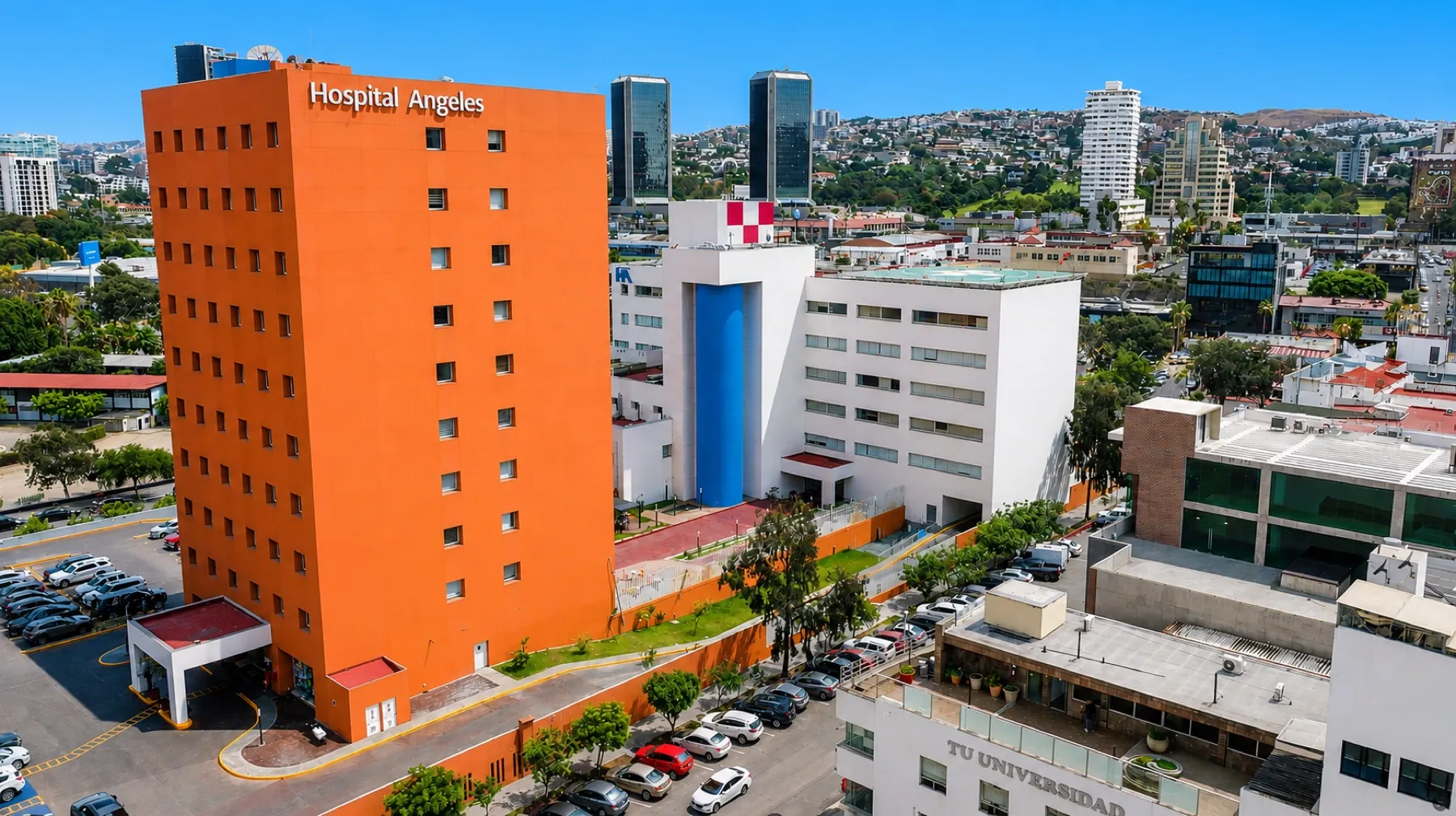
Most cell therapy in Mexico is delivered out of small, standalone clinics, some excellent, most not. A spine injection is the one place that difference matters most. Celva operates inside Hospital Angeles Tijuana: a 116-bed private hospital, part of Angeles Health, one of Mexico's largest private hospital networks.

Aerial view of Hospital Angeles Tijuana, the orange tower and the white hospital building beside it
Dr. Cesar Amescua, MD
Medical Director

Dr. Cesar Amescua, MD

Dr. Rocio Ambrosio Nuño, MD
Anesthesiology & Sedation

Dr. Rocio Ambrosio Nuño, MD

Dr. Alejandro Castillo, MD
Interventional Radiology

Dr. Alejandro Castillo, MD

The physicians on every chart. Full bios →

If it were ever needed
Typical MX cell-therapy clinic
Celva · Hospital Angeles
Live X-ray for every level
Ultrasound, or a blind injection
Fluoroscopy with contrast confirmation, every level, every time
Who is on site during your treatment
Whoever works there that day
The physician team, the anesthesiologist and hospital imaging, in the building for your session
Sedation for a procedure
Rarely available on site
Board-certified anesthesiology on site for your session

Ask any clinic what's in the building if a spine injection needs more than the room it's done in. Then ask us.

Book a call →

Disc-specific questions.

Is a bulging disc the same as a herniated disc?
No, and the difference decides a lot. A bulge is a disc that has spread past its normal edge with its outer wall intact. A herniation is a tear in that wall with the softer centre pushing through it. An extrusion is disc material pushed out past that wall, still attached to the disc. A piece that breaks off completely is a sequestration (a free fragment). Most disc problems, extrusions included, are cases the physician team evaluates for an injection, and referral to a surgeon is rare. A large fragment pressing on a nerve that is getting weaker is one of those rare cases, and we say so.
My surgeon offered a discectomy, not a fusion. Does that change anything?
A discectomy removes the piece of disc that is pressing on the nerve, and when that nerve is getting weaker, that is the right operation. When the picture is pain without a weakening nerve, a contained herniation, and months of conservative care that never held, the physician team evaluates the case for an injection first. The MRI and the call decide which of the two you are.
The epidural helped for a few months, then wore off. Does that rule me out?
No. A steroid calms inflammation for a while and puts nothing into the disc, so relief that fades is what a steroid does, not your back failing. A patient whose cortisone or epidural bought a few months is a common profile at evaluation.
Do you inject into the disc itself?
Depending on what the MRI shows: into the disc, around the disc, around the nerve root, or into the facet joint, at 1 to 3 levels in a session. Every placement is under fluoroscopy (a live X-ray) with contrast dye confirming the needle is at the right level before any cells are released.
Do I need a new MRI before we talk?
No. Send the MRI report you have, the images if you can get them, the level your surgeon named, and a list of what has been tried. If the imaging is old or the physician team wants a sharper look at the level, the MRI inside Hospital Angeles can image it during your visit, with the radiologist's read the same day.

The physician team. Your MRI. A straight answer.

Your first call is with a Celva patient coordinator, about 15 minutes, who collects your case and passes it to the physician team for independent review. Then the physician team tells you plainly, in writing: candidate, or a surgeon's case. No pitch either way, and nothing to commit to on the call.

Have ready: the MRI report, the level your surgeon named, and the list of what has been tried.

Book a call →
These therapies are not FDA-approved. Treatments are performed in Mexico by licensed physicians in a hospital setting. Individual results may vary. Not medical advice. Spine candidacy undergoes additional screening including neurologic assessment. Seek emergency care for sudden weakness, numbness, or loss of bladder or bowel control.